
INTRODUCTION
Accurate marking and detection of underground networks is a critical requirement for modern telecom, FTTH, and utility infrastructure projects. As network density increases and excavation activities intensify, the risk of damaging fiber optic cables, microduct systems, and other utilities becomes significantly higher.
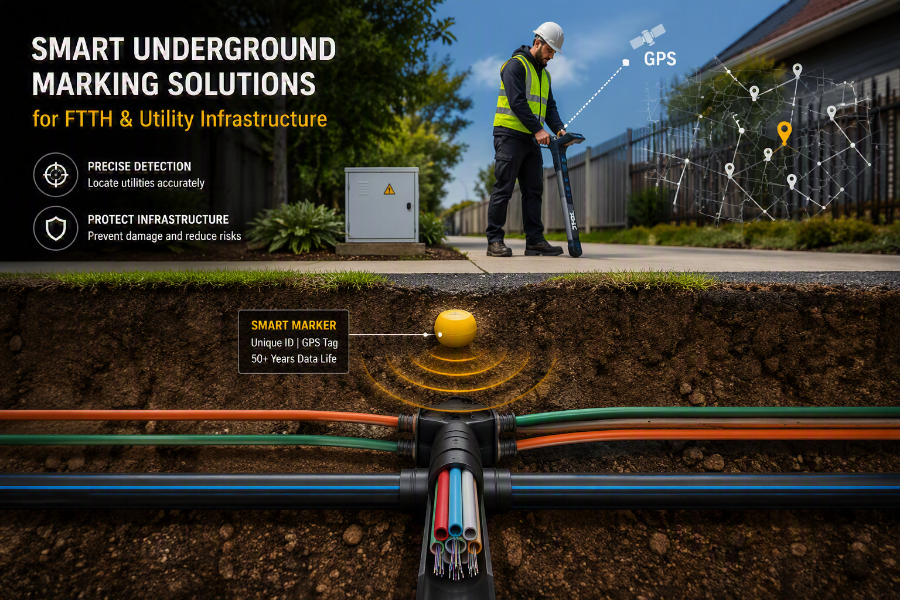
The latest generation of underground marking systems—combining passive markers, RFID technology, GPS-enabled locators, and cloud-based software—offers a reliable way to prevent costly damage, improve documentation, and streamline network maintenance.
In this article, we explore the Komplex underground marking portfolio, including Smart RFID systems and analog markers, and explain how these technologies support safe and efficient infrastructure deployment.
TABLE OF CONTENTS
- Why Underground Network Marking Is Critical
- How Underground Markers Work
- Smart RFID vs Analog Markers
- Smart RFID System: Complete Solution
- Product Portfolio Overview
- Deployment Scenarios (FTTH & Utilities)
- Best Practices for Installation
- FAQ
WHY UNDERGROUND NETWORK MARKING IS CRITICAL
Underground infrastructure projects—whether FTTH rollout or utility reconstruction—face a common challenge: lack of precise and reliable information about network location.
Key risks include:
- Damage to fiber optic cables, pipelines, and utilities
- Safety hazards for field workers
- Expensive repairs and project delays
- Environmental impact
The catalog clearly highlights that inaccurate documentation and non-metallic materials (like plastic pipes or microducts) significantly increase these risks.
👉 This is particularly relevant for FTTH deployments, where the majority of infrastructure (HDPE ducts, microducts) is non-metallic and difficult to detect using traditional methods.
HOW UNDERGROUND MARKERS WORK
Underground markers are passive RF devices that use electromagnetic communication for detection.
Key working principles:
- Contain a passive antenna tuned to a specific frequency
- No internal power supply → maintenance-free operation
- Activated by a locator device
- Can be detected regardless of pipe or cable material
Because they are passive:
✅ No battery replacement
✅ Operational lifetime of decades
✅ Reliable detection in harsh conditions
Markers are installed above critical points of the underground network to ensure precise identification during future excavation works.
SMART RFID VS ANALOG MARKERS
Analog Markers
- Passive RF markers without ID
- Cost-effective solution
- Best for:
- Straight sections of networks
- Less critical points
They provide reliable marking but do not store additional information.
Smart RFID Markers
Smart markers introduce a new level of infrastructure intelligence:
-
Pre-programmed unique ID
-
Ability to store:
- GPS coordinates
- Network metadata
- Custom user information
-
Data linked to specific network points
-
Lifetime data storage up to 50 years
👉 This makes them ideal for:
- FTTH networks
- Backbone infrastructure
- Smart city deployments
🔷 SMART RFID SYSTEM: COMPLETE SOLUTION
Unlike simple markers, the system includes:
1. Underground Smart Markers
2. SML Locator (with GPS)
3. Marker Database® software
The system enables:
- GPS-based navigation to marker location
- Cloud-based data storage and sharing
- Visualization on maps
- Data editing and archiving
👉 This transforms underground marking into a fully digital infrastructure management system.
🔷 PRODUCT PORTFOLIO OVERVIEW
🔹 Smart Marker Range
Smart Marker 1500
- Flat design for deeper installations
- Reading range up to 1.7 m
MAR 100-LQ Smart
- Spherical design for flexible installation
- High mechanical resistance
- Suitable for narrow excavations
PIN Marker Smart 60/40
- Designed for direct attachment to microducts
- Ideal for FTTH deployments
- Works in vertical and horizontal positions
🔹 Analog Marker Range
MAR 100-3D
- Spherical electromagnetic field for easy detection
- Robust and durable
MiM Marker 120
- Compact design for narrow trenches
- Cost-effective solution
PIN Marker 130/100
- Small marker for shallow depth installations
- Microtube compatibility
Marker 2500 & Long Marker
- Designed for deeper installations
- Reading depth up to 2.5 m
DEPLOYMENT SCENARIOS (FTTH & UTILITIES)
Typical applications include:
FTTH Infrastructure
- Microduct route marking
- House connection points
- Fiber branching locations
Utility Networks
- Gas pipelines
- Water pipelines
- Energy cables
- Sewer systems
Markers operate on different frequencies depending on utility type (e.g., telecom networks at 101.4 kHz).
BEST PRACTICES FOR INSTALLATION
To maximize reliability:
✅ Install markers at critical points:
- Branches and junctions
- Direction changes
- Depth changes
- Access points
✅ Use Smart Markers for:
- Important infrastructure nodes
- High-density FTTH zones
✅ Use Analog Markers for:
- Straight routes
- Less critical sections
✅ Combine with:
- GIS documentation
- Accurate record keeping
- GPS-based location systems
Planning Your Next FTTH Project?
FMC TEL supports operators, ISPs, contractors, and infrastructure providers with:
- FTTH infrastructure design
- OSP fiber optic solutions
- Gigabit broadband deployment
- Microduct systems and underground infrastructure
- Hybrid fiber and power cabling
- Fiber distribution and splice management
- Data center connectivity infrastructure
- Telecom deployment optimization
- Technical consultation and infrastructure planning
Our engineering-focused approach helps simplify deployment while improving scalability, resilience, and long-term infrastructure performance.
FAQ
Q1: What is the lifespan of underground markers?
Smart markers can store data and operate for up to 50 years.
Q2: Can markers be used with plastic ducts?
Yes, they work independently of material type.
Q3: What is the difference between Smart and Analog markers?
Smart markers store data and enable digital mapping, while analog markers only provide location detection.
Q4: Are markers maintenance-free?
Yes, they are passive systems with no power source.


